Friday, May 04, 2012

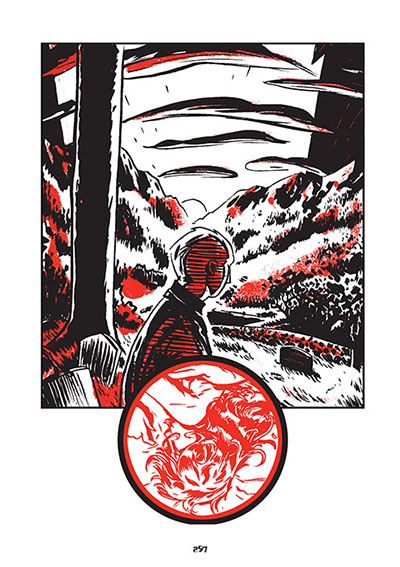
Wonderful Copenhagen, Allan Haverholm's Sort-Mund

I was obsessed with comicbooks when I was a schoolboy, American comicbooks.  During some lessons I sat daydreaming, especially when the lesson involved the teacher talking about her time in Dar es Salaam - which she did a lot. I tried to imagine what comicbooks they had there, and then I was off, staring over at the globe in the corner of the room and imagining what comicboks were like in India, in Holland, in Italy, in Denmark.

It's still a real treat for me to get my grubby little mitts on these treasures, and I love seeing them in their native language, rather than in English translation. That's why I was delighted when Allan Haverholm let me have a copy of his graphic novel, Sort-Mund, and had no problems with the fact that I cannot understand a word of Danish. I spoke with Allan about blogging on Sort-Mund, and making a stab at what is going on in it, using only the drawings to feel my way through the story, and he decided it would be an interesting experiment.  Besides, I figured that even if I was way off target with the story, I would still be able to share Allan's wonderful drawings with you.


A good place to start when you're reading a book is the title.  A lot of thought goes into titles. Somewhere in the house here I have a copy of the sheet of paper Dickens used when he was struggling to name Hard Times; he went through a lot of ideas before settling on that title. But I wanted to avoid looking at Babelfish and decided that Sort-Mund was a place.  It's not, I now know, Sort-Mund means Black Mouth, but I've avoided trying to translate chunks of dialogue because whether I've understood the text or not, I've been able to fashion some sort of story, in my head,
from Allan's drawings.


I love the opening page, our entry into the story, i's a stark, noirish, Dr Caligari-type cityscape, with Triffid-like tentacles breaking through the surface and blocking the path of a loan figure. He turns and races back the way, through a park, and then it becomes clear that the protagonist has been dreaming.  The scene then switches to a domestic setting, but there are one or two visual clues that this sunny morning may retain something of the strangeness of last night's dream.  The shadow of the window frame on his face forms the shape of the cross, outside his charming cottage, there's a black crow watching him collect his mail, the whistling kettle, the first real sound we hear screams across the page.  We're pretty confident something is going to happen and there's a hint or two that it might involve religion of some sort, death, and maybe even something Lovecraftian.        
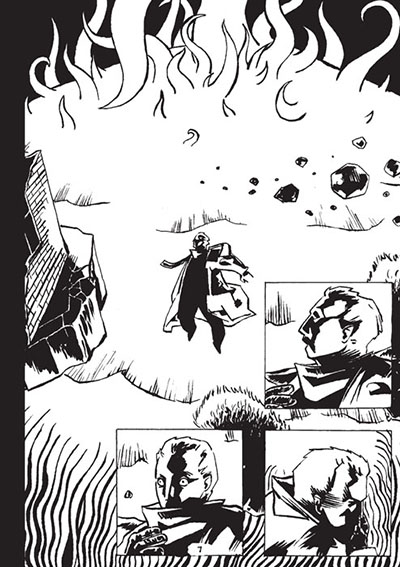


The letter causing our protagonist, Manne Svarts, to go collect something from a counter or teller or collection point 665 (almost 666 and just one of the numerical and symbolic hints and clues laced through the text), and there may again be an interruption from a dream or from an imagined war-time scene. This worrying thread, that suggests a fracture of some sort in our hero's thinking or even in his mind, continues as we move from the protagonist's reality of modern-day Denmark, of coffee houses and bus trips, back into his violent dream scape where he dreams within the dream and morphs into the violent perpetrator.  It's becoming clear that reality and fantasy are becoming problematic for our hero.


There are really nice shifts in POV as Allan introduces different characters, like the trendy young researchers, into the story, and the noir mood lights even the most cozy, domestic, scenes, warning us that there is a dark shadow hovering over the text.  That dark shadow belongs to Satan, and the introduction of a diabolical book is very well handled by the artist, with a nice change of lettering to establish the text of the book as separate from the text of the story itself and the angular drawing establish the book's illustrations as different from the reality-based illustrations of the story. The pace moves on and the story carries us into some exciting visual areas as a modern computer-driven reality, and a dream scape melded to chessboard, swirl around the pages and remind us of the famous scene in that old movie where the Gods summon the Titans and play chess with human lives.


It soon becomes clear that the violent dreams have some basis in reality, and that people in Copenhagen are being killed.  And our protagonist's vivid nightmares, his day dreams, and the voices he is hearing in his head, have to lead us to wonder if he maybe isn't actually polishing people off himself.  But he is just one of the suspects in this tale that jumps time zones and hints at macabre doings and arcane knowledge, and I'm now suddenly conscious that I might accidentally stumble onto the truth of the story and produce spoilers, so I'm going to stop now. 


I think Allan has produced a pretty impressive graphic novel with Sort-Mund, and I wish I'd got it years ago when it was first published.  The sheer amount of experimentation with lighting, with the lettering, with the panel structure, puts me in mind of the sort of experiments that Joyce dabbled with in Ulysses. In many ways, Allan has made some very bold decisions in Sort Mund, and it's a book that should be studied by other graphic novelists because it has some pretty fancy pen work and some great ideas.


Saturday, April 28, 2012

Picking Over Eric Orchard's MarrowBones


I like Eric Orchard. I like Eric's work too, he has a lightness of touch, and can invoke a genuine sense of creepiness that is almost in the same league as the feeling of Unheimliche that Renee French captures with her drawings. But his talent doesn't end there, dammit, he can also write well, as his latest comicbook, MarrowBones, clearly shows.


It's a difficult thing to do, introducing your imagined world to the reader for the first time; in any medium. But I think it is especially difficult in a graphic story, as it often requires a degree of verbosity that limits the area that can be used to illustrate exactly what is going on.  In a Gothic poem or story, the scene can be set quickly, and effectively, and economically, with very little need for the reader to do any work: "Once upon a midnight dreary..." immediately sets the scene for the reader, and the rhythm and cadence drives Drearily Down as the mood is hammered home. Within seconds we are partners in the bleakness.  In a comicbook the dreariness has to be illustrated, literally, and you can't cheat, you can't just draw a darkened sky and have one character blurt out "what a dreary place".  Well you can, I suppose, but the reader will see through that approach soon enough.  The reason Eric Orchard succeeds in quickly imparting information about the world the reader of MarrowBones will inhabit, quickly, is because all the visual clues are there from the very first moment the reader interacts with the book.  Everything, from the fetid, dripping, Marrowbones logo, with its cleverly incorporated skull, to the cover design, to the muted palette, and the choice of  lettering, all works toward one end, establishing the Gothic tone that is both uncomfortably strange and because of our experience of other Gothic tales, uncomfortably familiar.  It is, a fully imagines world and we have every reason to believe the author when he claims that the project has been gestating for some time.


The cleverness of the tale is in using a crypt-keeper-type of character as a narrator. This is a nod to comicbook history, as it invokes memories of the old 1950s EC comic Tales from the Crypt, and many a horror comic and TV series and movie since, and it is also an extremely effective way of establishing the history of the imagined universe as economically as possible.


MarrowBones also succeeds in bridging the gap between a cute vampire tale like Hipira, by Katsuhiro Otomo and Shinji Kimura, and the outright horror of Junji Ito's vision.  Somewhere between both these extremes, lies Marrowbones and it is a very welcome addition indeed.   


MarrowBones Issue One can be downloaded for around $2 from Eric Orchard's blog at http://ericorchard.blogspot.co.uk/ .

Wednesday, March 28, 2012

Imagine a Noise like Blerp.

Hi.  I hope this means I'll shortly be back at the, ahem, grind.  I still have to be scanned in a giant cigar-tube and have more blood tests, but I'm hoping it will be the last round of that stuff and I can put it behind me.  Thanks for asking after me; I'll be in touch very soon.

All of a sudden, earlier today, I got a little interested in things again.  It came out of the blue, and I think it had a sort of "blerp" sound to it.  Suddenly, I started picking things up and looking at them.  I even turned the Wacom on and I could draw with it; which was a little shocking because I thought I might have fogotten how to. 

I also became interested in looking at comics again. This time round I haven't been, but I have been reading, Mapp and Lucia, and Berlin Stories and Tales of the City and The Woman in White, and others, but no comics.  And I've been looking at manga again; which has been great.  It has been fun catching up with Kurosagi Shitai Takuhaibin and with the Tenpai series and I'm looking forward to blogging about them; soonish. Meanwhile, here's a little look ahead at KCDS #15:


By the way; Blogger is a nightmare to type with just now.  Is it all java now?  Not very user friendly at all. Hopefully that will change.

Friday, December 16, 2011

Sorry, been ill

May be a repeat of the 2009 stuff. Yucky, but back soon.

Monday, September 26, 2011

Of Death and Music

So I'll be posting some drawings soon. I'm writing a story about a DJ in Edinburgh, in the 1970s, which has some actual people in it and some fictional ones, and lots of real places- and its skeleton is the legend of Orpheus.


The legend of Orpheus is well-known. In Greek mythology, Orpheus was a troubadour from Thrace. He charmed even the animals. His songs diverted his attention from his wife Eurydice. Death took her away from him. He descended to the netherworld, and used his charm to win permission to return with Eurydice to the world of the living on the condition that he never look at her. But he looked at her-


Hello.
Hello.
- Do you know who I am?
- I do. - Say it.
- My death.
Good.
From now on you will serve me.
I will serve you.

Monday, July 25, 2011

Up to Speed - stoopid Rod

Lummy; it never occurred to me (until now) to post something. Here's what's happening; I've drawn some of a story set in the 1970s disco scene in Edinburgh. I've drawn Flash Harry and Roxy Callaghan, and the beginning of the story, which features some pubs and many of the clubs; but I can't post any drawings because I've packed them away for safe-keeping...I know; dumb!

I'll fix this as son as I can, because I'm away for anther 5 weeks and I can't go that long without doing the work. I've kind of decided to start work on another section of the story, and I'd really like to post the work in progress; not least because it lets me see if it's working out; but I have no tools with me at all. Not even the wacom. I honestly deserve a good slap.

The only thing that is making it all worthwhile is watching my minging wife slob around complaining about me leaving her clothes behind. If I didn't have her to look at, with birds in her hair and her baggy tramp clothing I wouldn't be having any fun at all.

Thursday, June 16, 2011

Be Very Careful What you Publish Online

That's a given; right? I mean we all looked over the twitpic copyright announcement where they seemed to be claiming the rights to the "photos" (including artwork), posted onto their site.

And we are all aware that despite insisting that their own online material is copyright protected, newspapers and magazines have published drawings they "found" online claiming they thought the work was "in the public domain".

But there is another area you have to be wary off, that's the area of creative license. Be sure about what rights you are giving away, and be clear in your own mind what rights you are keeping. The reason I bring this up is because publications like the "United Kingdom Comics Creator Introduction..." exist, without you knowing anything about them:

The "Publisher's" Synopsis

Editorial Reviews - United Kingdom Comics Creator Introduction From the Publisher
Purchase includes free access to book updates online and a free trial membership in the publisher's book club where you can select from more than a million books without charge. Chapters: Colin Macneil, Leah Moore, Arthur Wyatt, Eric Bradbury, Emma Vieceli, Dave Follows, Chris Bunting, Steven Appleby, Charles Peattie, Robin Smith, Mick Anglo, Joe Berger, Robert Nixon, David Law, Lee O'connor, Michael Molcher, Larry, Davy Francis, Scott Goodall, Richard Piers Rayner, Graham Higgins, Rod Mckie, Pete Loveday, Tom Kerr, Tom Frame, Gina Hart, Scott Gray, Hunt Emerson, Daniel Vallely, Tom Gauld, Mike Pearse, Reg Parlett, Simone Lia, Bob Lynch, Phil Hall, Ken H. Harrison, Reg Bunn, Timothy Birdsall, Russell Taylor, Henry Matthew Talintyre, Lawrence Goldsmith, Pete Nash, David Austin, John Dallas, Eric Stephens, Henry Seabright, Kenneth Norman Lilly. Excerpt: Colin MacNeil is a British comics artist, best known for his work on 2000 AD and in particular on Judge Dredd and other stories within his world like Shimura and Devlin Waugh. ... More: http://booksllc.net/?id=12627511


http://www.bookadda.com/product/united-kingdom-comics-books/p-9781157502142-1157502148

This print-on-demand publication, by US company Books LLC, gathers information from the internet, from sources like Wikipedia, and makes that information available to subscribers:

http://en.wikipedia.org/wiki/General_Books

The Metro actually did a piece on this practise earlier in the year, but it kind of slipped under the wire:

http://www.webcitation.org/5x4KWQJeT

Now there will be some people who think this is okay because it's "exposure". It's not okay. If you didn't intend your information to be harvested in a list, or a book, it shouldn't be. Also, if you post illustrations and these people publish them, particularly in the US, you will technically be in breach of contract if you subsequently sell the "First North American Rights" after that happens.

Thursday, May 26, 2011

Contradictory Advice

When the advice seems to be contradictory, such as "finish what you start" and "don't get married to an idea", you have every right to wonder if there isn't some other rule-of-thumb that needs to be applied to tiebreak the situation. What I think these seemingly conflicting pieces of advice, both of which you'll find on this blog, mean is "finish working on whatever you are working on at the moment". In other words if you feel you are running out of steam after half a page of a comic idea, try to stretch it to one full page, that's finishing what you started, and it can always go in your portfolio. It is never a waste of time, at the very least the simple exercise of drawing always improves your drawing skills. And if you have sketched up a character and written a little note beside it, try to work it up to a synopsis; I mean who knows, it may be that after that exercise it develops legs again.

As for "not getting married the an idea", that really is just a warning about the nature of the business. You are, after all, in the ideas business, and you need to keep churning out new ideas. Unless the project you are working on is a real labour of love that you will continue to produce for yourself even after picking up a paying gig; put it away in a drawer. Again, you just never know, it might be that 6 months down the line you'll open the drawer, look at that project and it'll look good to you all over again.

So, what about putting these ideas into practise? Well, hat's a wee bit more difficult, especially when you can easily imagine yourself completing everything easily and on time. Well, you have to take stock, I'm afraid, you just have to, there is no avoiding it, even if it means admitting that you are only human. It is also a very valuable exercise because, in case you haven't noticed it is happening, you will soon find out if you have become an obsessive, slightly manic, gibbering wreck; which is, by the way, what you will become if you continue to try to work on everything all at the same time.

One project I have in the drawer at the moment is Mandrake Falls, which I hope that one day Dwight McPherson and I might finish together, along with a colourist (I hope). The plot, Dwight's, is still strong, the title is great, and the thing looks good, think (see below); but it is an idea, I think, that will profit from being in the drawer for maybe 3 months - which, coincidentally, is exactly the size of my backlog; although that may even be an underestimate.


Extracted from Mandrake Falls, copyright Dwight McPherson and Rod McKie, 2011.

Thursday, May 19, 2011

Sam Klempke, Cartoonist and Time Traveller

I'm drawing a little something after watching Sam Klempke's time lapse movie of his life. The film is a 7 minute digest going right back to the 1970s, and it intrigued me because I don't have any film of me back then; not many of us do, but I can revisit those days through the filter of imperfect memory by drawing a comic strip. Interestingly, Sam never drew caricatures of himself as he saw himself at the end of every year, which might have been nice, but it's a captivating look at the passage of time. Anyway, I've posted Sam's movie here and I'll post the comic in the next blog post.


Sunday, April 17, 2011

In the Meantime, Here is the Spite.

I think spite is often overlooked as a reason for doing things. I've decided to learn Gaelic for spite, and I'll probably speak only Gaelic at times to annoy people.

Not really, I actually fancy learning it for a couple of good reasons, and since Easter is almost upon us, and it's Sunday, and I was listening to these things anyway, I thought I'd post a couple of Gaelic Psalms. The language, when lined-out like this, or call and repeated in song, sounds ancient and rooted, and I like that. It sounds, to me, like Native American song, which is always going to seem cool to we fans of old Saturday Matinee cowboy shows who supported the alleged bad guys.


Sunday, March 06, 2011

TV Tornado

TV Tornado (City Magazines Ltd, Edited by Mick Anglo) was a fantastically exciting comic. It was really in tune with all the new and exciting things that interested young readers like me. It combined the newest most exciting TV shows, The Invaders, The Man from Uncle, movie characters, Tarzan, Saturday Morning Matinee shows, Flash Gordon, and comic strips from the newspapers and American comic books, the Phantom, The Lone Ranger, and Magnus Robot Fighter. It was what my small group of friends and I spoke about as we read the comic together on my doorstep, in the playground, and it was the first comic that we knew, just knew, lots of other people must also be reading. It was a comic for our times.


In fact, it was so current that rather than hating it, many parents, like my dad, a big fan of the old Lone Ranger radio and TV shows, and the new Lone Ranger and Tarzan TV shows, and all the brilliant new US sci-fi shows; loved it. Even my non-comic reading friends (of which there were many) liked it because it also featured their TV favourites in comic strip form, the Green Hornet, and Batman and Robin, which in turn turned their attention back to the comic books that spawned those TV shows.


To be honest my dad was such a fan of the Garth and Angus Ogg comic strips, it wasn't difficult to get him to read comics, but for other comic strip-sceptics, young and old, there were partially illustrated popular adventures in TV Tornado, such as The Man from Uncle and The Invaders, that could tease them in.


I've included this advert for a couple of reasons. One is because it's just brilliant. Another is because I had those boots, and I loved them. I never once had any practical use for them, but I thought they were great and it seemed like these were ideal footwear for Scouts.


My two absolute favourites from TV Tornado were The Phantom, and Magnus the Robot Fighter. The Phantom was ubiquitous, it still appeared as a Saturday Matinee serial, it was a regular comic strip, it sometimes had entire issues of Alan Class Comics devoted to it, and now here it was in TVTornado - and it was still hugely exciting.


I loved Magnus. I loved the way it looked. I loved the colour comics from Gold Key (Gold Key comics always had fantastic covers) and I loved the line drawings in TV Tornado. Years later I would discover who drew it, but back then I was really taken with the shapes, the way the panels were filled, and with Magnus's hair.


Thursday, December 23, 2010

Blank Slate, Blazing a Trail

I started out to write this by grabbing a couple of books from the bookshelf: The Piers Plowman Tradition, ed' Helen Barr, Theory and Cultural Value, Steven Conner, British Writers of the Thirties, Valentine Cunningham, and Modern Literary Theory, eds Philip Rice & Patricia Waugh. I was going to include ideas about the notion of dangerous literature, the way "graphic novels" are viewed as cultural artifacts rather than works of art, publishing cliques, and the literary Canon, and literature as an ideological form, and how all these ideas relate to graphic novels today. Then I looked at my collection of Blank Slate books, and thought about the scans of the artwork from inside those books, and I realised that if I started going on and on and on about all that "stuff", we just wouldn't have the opportunity to enjoy the books themselves. Which really defeats the entire exercise, doesn't it?

So let us start with what matters; the books themselves; the covers, the work on the page, the drawings, the paintings, and the words. And the differencse between the individual books. The difference between the works Blank Slate is producing is very important. The eclectic mix of their books puts me in mind of, and it might just be because the stark black and white cover of Darryl Cunningham's Psychiatric Tales puts me in mind of the logo, Stiff Records, during the birth of Punk. Although, having said that, I don't think it's just a superficial resemblance, to me Blank Slate is part of a Punk movement; they are, arguably, the Sex Pistols or the Clash of British publishing.


My main fear for graphic novels in the UK was, as I made clear in this blog-post in 2007, that the creative talent here in the UK would have to continue to go abroad, or self-publish, or create comics rather than books, because the gatekeepers of literature in Britain have no idea what this new artform, the "graphic novel" is. Oh, they are perfectly happy to reprint successful graphic novels like Persepolis, or Ghost World, but they are not really prepared to encourage new talent over here. And that, as I recall from my time as a DJ, is a situation analogous to the music scene in Britain in the late 1970s when the major music labels and the BBC music shows and chart compilers (there were 2 number 1s and the BBC didn't play punk) just didn't "get it".

And what is it they just "don't get"? Well, it is, apparently, the often symbiotic nature of words and pictures in a graphic novel, and the possibility of the continuing movement of narrative and description through, sometimes, the illustrations alone.


Which brings us neatly to the work of Oliver East. I have to admit that to someone used to just reviewing or reading words on a page, looking at Oliver's books might be something of a culture shock. His pages sometimes look like Medieval English tapestries, the panel borders hinted at with trees or fences or roof tiles or dialogue or leaking into one another. It is often a landscape one second civilised and the next primitive, as his story continues its movement of narrative and description through the words, word and picture combinations, and even through illustrations alone.


Like most works of art, East's stories can be enjoyed on a number of levels, but if you are willing to make the effort, they can be very rewarding indeed. I like to speed-read on my first run at a book, and what struck me when I first flashed through East's work was, as I have mentioned, the tapestry-like look of the work, it's autumnal colours often merging town and country into one landscape. It also reminded me of allotments, of cities and towns, viewed from the windows of a train flashing through the countryside - occasional blinding me as the sunlight made me look away. This is, I think, where a book like East's Proper Go Well High, for instance, works so well, there is such momentum in the visual narrative, that the train journey is almost a stream of consciousness, playfully distorting the pace of the written words, slow then fast, then trailing off. I think I've read this book about six times and counting.


I've mentioned the "differences" in Blank Slate's range of books; of course there is a range of titles with traditional mainstream publishers, but that range is more genre than anything else - typed words are typed words, after all. But traditional large mainstream publishers do generally publish a wide range of illustrated or picture books, and that is often not the case with independent publishers who publish graphic novels. Some independent graphic novel publishers insist that all their titles look like they've been drawn by Frank Frazetta, or by some superhero comic artist, so whilst they may publish a range of titles, they publish a range of titles that all look alike. I can think of a number of independent publishers who would not have published Darryl Cunningham's Psychiatric Tales simply because of the way it looks (like me he draws very flat) and I'm betting there are more than a few who would have been too timid to publish it because of its content. But it is proving to be a solid ambassador for Blank Slate because it is a little gem of a book.


I like Darryl Cunningham's drawings. As you can see from my terrible lo-res scans they are legible even at this tiny blogger-friendly size - that's not easy to accomplish - and it is something that will become increasingly important as this book is ported to other mediums. The drawings, black and white line with solid black used as a colour, are tremendously effective and I don't know if it was a conscious decision (rather than a financial one) to use this format to illustrate the often black and white issues around mental illness; but it was undoubtedly the right one.


This is a thoughtful and tender work, sometimes at odds with its less than tender subjects. I love the page above, one panel of which is being used for the cover of the US edition of the book, it pulls back from its subject making him small and human as it does so.


I think that is what is at the core of this book; is its humanity. It's a study, and not simply a superficial one, of a difficult subject, handled with care and despite the fact that black and white artwork can often be brutal, with tenderness. Psychiatric Tales will, I think, one day, be seen to be as important a graphic novel as Mom's Cancer by Brian Fies.

In addition to publishing new work, Blank Slate are introducing some established overseas cartoonists to Britain. The story of Sparky O'Hare, Master Electrician, by German cartoonist Mawill, is incredibly silly, but great fun. Mawill makes no excuses for a world where the central character is an electrician who happens to be a Hare, and nobody seems to notice, except to crack the odd joke about his funny looks and his lack of height. There aren't enough little quality pocket books like Sparky O'Hare around; it's a marvelous little book.


I remember, a few years ago, that Patricia Storms asked the question "why are graphic novels so bleak, obsessed with autobiography, and so lacking in humour?". When we tried to put our heads together and come up with an answer, the best we could do was suggest this was maybe an attempt to establish the artform as "serious"; especially in the eyes of those who regarded graphic novels as picture books. It was, and remains, a very good question. It must look to outsiders as if cartoonists really are a bunch of whiny bitches; too insecure to lighten up and have some fun. Although it is worth bearing in mind that the cartoonists are not publishing the work, they are simply producing what the publishers are willing to publish. It would seem to be the publishers themselves who are insecure about the work.

I think printing Sparky O'Hare shows that Blank Slate have no such insecurities; they love comics and it shows. There is no better example of that than Nigel Auchterlounie's Spleenal comic. This collection, in a book for "over 18s" is a joyous little foul-mouthed smut-fest that delivers a thick compendium of the sort of comics one used to find in the old skin-mags. It's uproarious fun. It's not Nigel's "Ulysses", but it's a great read and its full of marvelous drawings. There just isn't enough of this stuff being printed.


I'm delighted beyond mere words that Blank Slate has reprinted Belgian cartoonist Randall C's Sleepyheads in its original format. It's a gorgeous production, and a marvelous book. The comics, stand-alone and also linked by themes of dreaming and the sea, and by a story that comes and goes like the tide itself, manages to combine both the playful qualities that Blank Slate are not afraid to embrace, and a deeper level of meaning. Each chapter, or vignette, like "The East", printed below, is like a little masterclass in cartooning. The position of the text, the shape of the word balloon tails, and the body language of the actors, controlling the languid pace of the story:


I could go on filling this page with scans, but I'd urge you buy this book and see it for yourself. There is, for instance, a page in chapter two of Sleepyheads, The Sea, where the protagonists are discussing that song of clouds that for me boarders on the sublime. I can't recommend it highly enough.